Mental Post-Its

Thoughts, Notes, and General Mental Mayhem


Leave a comment

Echo Conference (Abridged)

This past week, I was in Dallas for the Echo Conference. It’s for artists, geeks, and storytellers in the church, and was my first time attending. It was pretty cool, and quite different from my usual conference experience. I tried to take good notes for you and me both, and while it would be a pretty long post if I included each and every note here, I will include some of the highlights.

Here are a few of the gems I appreciated most:

Cole NeSmith: Creativity Overcoming Safety

  • “The Artist as Prophet” –A prophet is someone revealing the truth of God. In life and the church, we become subservient to someone else’s agenda, but God has given us our own unique things to say in a way that no one else can. God is revealing his manifold wisdom through the church. (Eph 3:10-11) There is still plenty for us to say.
  • Creatives can sometimes see what others can’t. A Radio Lab podcast by NPR explained that the original Hebrew Bible and Homer, as well as other popular ancient texts, do not use the color blue. They do, however, use most other primary colors. So a tribe in Namibia was studied who only had five names for colors. When shown a color outside their only five, they couldn’t see it. Artists often can’t see what we don’t have words for.
  • Artists have prophetic permission. We are expecting and ok with artists making us uncomfortable. Artists must respect authority, but are not subservient. The artist is a risk-taker who goes into new territory first to illuminate it. In fact, a Barna Study found that people were leaving the church because it is too safe!
  • Success is related, not to outcome, but to obedience. Our willingness makes it a success.

The Amnesia Project: Marlon Hall

  • Dream. Believe. Do.
  • The heart of imagination is memory. Go backward to go forward. How can we imagine our future if we don’t know who we are? As amnesiacs, we must wake up from amnesia to remember the past so we can effectively shape the future.
  • We tend to focus on what, who, where and how but not enough on why. Why is the source. Your heart is attacked when you don’t remember the why.
  • We don’t see things as they are. We see them as we are. Perspective.
  • Assess your failure. Use the crap of your past to fertilize your future. You must fail in order to succeed well.

Keynote 1: Todd Wagner

  • Don’t look at someone’s success as your failure. It’s probably meant to bless you, so don’t take that opportunity for blessing away. God knew what He was doing when He made you. Be inspired and encouraged by those you see as great.
  • Col 1:25 – God put Christ in us to reveal His glory. God has entrusted His glory and reputation in the form of us. He stakes His reputation as a Creator in us. We are fearfully and wonderfully made and remade daily. Our lives are meant to point to Christ and have others want to do the same.
  • Two people can tell you the truth about yourself: an enemy who has lost his temper, or a friend that loves you dearly.
  • The logo of the NBA is a real guy, not just a graphic or model. We are God’s logos that represent Him to the world. What would happen if someone pulled back the curtain of your life? (Wizard of Oz)

Keynote 2: Todd Henry

  • Author of “Accidental Creative”
  • Is it possible to be prolific, brilliant and healthy? Probably two, but rarely all three if at all. We usually end up fried. We can become unreliable because we can’t keep up the pace. We can become fired if we don’t constantly do great work. How are you doing on these?  If you are missing one, it’s usually the healthy piece.
  • Sometimes we don’t see the pressure because it’s been there for so long. The moment we have a great idea, the stakes are raised.
  • We are in a create-on-demand world. The creative process is the perpetual assault on the beachhead of apathy.
  • Five Steps: Define the problem. Explore the options. Choose the best option(s). Execute. Rinse and repeat.
  • Are our ideas to appropriate (safe or close to us)?
  • Creativity is rhythmic.
  • Focus – Sometimes we think something out there is more important than what’s right in front of us. (Twitter, email, etc.) We think nothing of giving away our life 10 seconds at a time, but it adds up!
  • Define Challenges – ask multiple questions.
  • Relationships allow us to pursue meaningful things. Seek relationships that challenge you.  Seek out people who inspire you. Seek mentors who help you define priorities and problems.
  • Energy – Mange it effectively to be your best. Prune regularly. It may be good, but not right at the time. Think whole life, not compartments. Get good at sitting down and evaluation.
  • Hours – Where you put your time can determine your success. Dedicate time to generate ideas for the things you love. Your priorities are with your calendar and checkbook.

Live Creatively: Amena Brown

  • Live creatively, friends…Make a careful exploration of who you are and the work you have been given, and then sink yourself into that. Don’t be impressed with yourself. Don’t compare yourself with others. Each of you must take responsibility for doing the creative best you can with your own life. – Paul (Gal 6:1,4-5, Message)
  • Artists need a place of prayer. Jesus climbed the mountain so he could be by himself and pray. He stayed there alone, late into the night. (Matt 14:22)
  • Artists need a place to be creative. In order to be creative you have to know how to prepare to be creative.  – Twyla Tharp. It may be your house or outside of it. Be consistent. Do your work.
  • Artists need a place to be transparent. Make this your common practice. Confess your sins to each other and pray for each other so that you can live together whole and healed. (James 5:16) Be accountable to someone. Don’t surround yourself just with people who are impressed by you.
  • Artists need a place to connect with other artists. Be around people who are better than you to inspire you to be better.
  • Artists need a place to cultivate your craft. Who am I to think I can build a house adequate for God—burning incense to him is all about I’m good for! I need your help. Send me a master artisan…” – Solomon (2 Chron 2:6-7, Message. Getter better. Offer the best you have.
  • Artists need a place to connect with your local art scene. Go out into the world uncorrupted, a breath of fresh air in this squalid and polluted society. Provide people with a glimpse of good living and of the living God. Carry the light-giving Message into the night. – Paul (Phil 2:14-16, Message).
  • Some thoughts on becoming a full-time artist: Completely surrender. Ask God what he wants to do with the gifts he’s given you. Be willing to scrub toilets. They are a means to an end. Remember you are serving God above all else. Study the artists who come before you. Push the art forward. Let them be your mentors. To be a full-time artist is to be an entrepreneur. If you don’t want to think about the biz side, keep it a hobby. Make the most of your day job. Save money. Decrease expenses. Live on less. Be yourself. Be who God called you to be.
  • Establishing some sort of routine helps you get through the hard mental days. Also expose yourself to new things to keep you inspired and creative.

Good Idea, Now What: Charles Lee

  • What do our ideas have to do with the real world? Ideas are a stewardship.
  • We will work extra hard if we think our idea is valuable enough.
  • Who are you, and who/what are you leading? Mission statements don’t cover these questions well, but they are crucial to understand. What do you bring to the table? Create a remarkable experience that people care about. Some of the best ideas come from those you serve. Consider the end user. Put yourself in the shoes of the person you hope to benefit.
  • A study found that those who talk about their ideas and share them too quickly without writing them down and processing them will rarely pursue or accomplish them. Write them down process them. This task also allows you to plug others in faster when you’ve thought through the details and then share with others.
  • Creativity and idea-making: Perseverance brings things to life. Ideas must be nurtured. Separate ideas may even come together over time.
  • Think options first. Malcolm Gladwell’s “Speghetti Sauce” TED talk…there may not be a “best” way to get there. People respond to options.
  • Simplicity and clarity. Take the concepts and prune them. People will connect to your core competency.
  • Ideas create tension. This is a good thing.
  • What are you waiting for?

Gaining Influence and Mobilizing Others for Good: Lindsay Nobles

  • Influence: to be a compelling force on something. Influence is more important than authority in today’s world.
  • In gaining influence, you need to be yourself and be authentic. Find your passion, and be a part of the story.
  • Don’t let fear squelch your visions. Enlist others. Surround yourself with people who affirm and hold you accountable. Your online persona should match who you are. Be generous and kind. Give your time and resources away the way someone else did for you when you were starting out.
  • Don’t talk about yourself all the time. (80% others, 20% yourself)
  • There are three ways to pull people into a story. Logical appeals to their head. Emotional tells a story to compel their emotions. Cooperative draws parallels between people and situations
  • How do you leverage influence? Focus on the people you naturally have influence with first. Deepen those connections. Let the broad come later. Let people see your flaws. Learn more about the things you love.
  • Sometimes its not about getting answers, but more about formulating the right kinds of questions.

Keynote 3: Tony Hale

  • You have to have a support system. He started The Haven in NYC as a Christian support system.
  • Entertainment is a constant faith walk. You don’t know when/where your next job is coming. It’s awesome to know God has your back.
  • His favorite movie is Lars and The Real Girl because it shows our desperation for connection.
  • We can’t put Christian art in a box. It can be outside a Christian bookstore.
  • If you are judging something or someone, ask yourself if those qualities also live in you. The answer is probably yes, so don’t judge too harshly.
  • Character development can be a study of empathy.
  • If you aren’t practicing contentment where you’re at, you’ll never be content when you get what you want. Contentment is a discipline. Practice it daily. When discontentment comes, tell it “not now.”
  • If you don’t surround yourself with people you really know you, you’ll lose yourself when the people who only know and love your work are the only ones around. It becomes your identity.
  • If I say yes to something I’m not comfortable with, they won’t get 100% of me. I’m doing them a favor saying no.
  • Don’t put up a wall—collaborate.

Keynote 4: Scott Williams

  • We are all storytellers.
  • Unity can be expressed through diversity. Gal 3:28 – neither Jew nor Greek, slave nor free, male nor female, for you are all one in Christ Jesus.
  • Live the Great Commandment. Matt 22:7-9. Love the Lord God with all your heart, soul, mind and strength. Love your neighbor as yourself.
  • John 4:27-30 – Woman at the Well. Why aren’t we more like the woman—going out telling everyone we meet about our life-changing experience with Jesus? Many believed because of what she said, and then went to hear Him themselves.
  • What stories are you telling? We all have a powerful story to tell!
  • Diversity matters to Coca-Cola and they are just selling sugar water. We have the Living Water. Diversity should matter.
  • Do the Great Commission. Matt 28:19. GO and make disciples of ALL nations.

I also walked out of the conference with a reading list:

  • The Accidental Creative: How to Be Brilliant at a Moment’s Notice by Todd Henry
  • Untitled: Thoughts on the Creative Process by Blaine Hogan
  • Good Idea. Now What? by Charles Lee
  • The Creative Habit by Twyla Tharp
  • The War of Art by Steven Pressfield
  • Quitter by Jon Acuff

Hope you learned something! I sure did!

Leave a comment

On Having Dual Personalities (of Sorts)

I have two people living inside me.

They fight for my attention.

Some days one wins; some days the other. But I’m not sure both can ever win at the same time.

I wouldn’t call them Dr. Jekyll and Mrs. Hyde. I wouldn’t call them Two Faced. Though two opposite sides of people are often expressed in movies, TV and literature as only good and bad, I find myself with a good and good. At least that’s what I’d call them.

The first me likes having a home, likes making the home look nice, and really likes acquiring stuff. She doesn’t crave stability by any means, but she likes a framework to move within. She doesn’t want to own a house for that still feels a bit like a cage, but she likes making the home she lives in feel warm and inviting. She likes buying books and movies and decor and electronics and kitchen appliances (though she doesn’t know how to use them very well). She doesn’t enjoy clutter, in fact she periodically purges to avoid extreme excess, but she does have comfy surroundings and a VERY long Amazon Wish List. I wouldn’t say she puts down roots, but she does enjoy watching relationships, places and surroundings grow to be a part of her. She doesn’t resist change by any stretch of the imagination, but maintains a flirtation with it, and welcomes it in from time to time.

And then there is the second me. She regrets the day everything she owned didn’t fit in her car anymore. She likes the idea of a well-decorated home, but isn’t convinced she needs it for herself. She only needs a reliable car to get her to where she wants to go next. She thinks she’s got some gypsy blood in her, but isn’t sure where it came from, because every couple of months she’s ready to move. To see new places. To have new experiences. She wants every day to be different and unknown. She thrives on adventure. She despises acquiring stuff because 1) she really doesn’t need it despite her wants and 2) so many people around the world have so little. So why not send the money and stuff to them instead? She doesn’t resist change; she embraces it with a huge smile as if it’s always overdue.

While reading about the two sides of me, you most likely identified more with one over the other. I think most people do. I’m sure even the more “tame” side of me isn’t near stable enough for some of you. (I know that because I’ve talked to you.) And in fact, the opposing side may even seem ludicrous to you. But, I promise, these two people live within me. Neither is bad.

Different isn’t bad. It’s just different.

But I’ll tell you one thing, it’s really hard for these two to take up occupancy inside me. The first side side has been the side that shows up most often, and sometimes I really am unsure why, while the second side plays the prominent role at only certain times. But usually, the side that isn’t winning is screaming to be in front. I’m sure the means and opportunity are the only thing standing in the second me’s way.

I think we’re often taught by society that my second me is flaky or irresponsible. Sure, it’s romanticized in movies, TV and literature, but when it comes down to it, come on? You can’t really live that way.

But I disagree. Didn’t the apostles live like the second me? I’ve lived like the second me at times and enjoyed the heck out of it. Not everything has to change in a couple thousand years. Don’t the aforementioned romanticized people often inspire you? They do me. And you only need know me to know that no matter which side is dominant, I’m not flaky or irresponsible. I may take risks, but they are calculated and prayerful. I just don’t understand life without risk. What a bore! I certainly don’t want to live that way. Both me’s need a calling, adventure and to be part of something larger. That is a constant no matter which side is taking the lead. That’s what I believe being a disciple of Christ is all about.

Control is out of my hands. Though I’m still in recovery, I tried to let go of my control freak side a long time ago. What a waste of time–trying to control. I was only trying to do a job that I professed was God’s, but in the end, must have secretly thought I’d be better at. I learned submission, and in that, opened new doors to adventure. Liberation. Now I understand truly what freedom is about. Some adventures are more tame, and they are for the first me. They are every day adventures (yes, they exist). And then there are the epic ones for the second me, and they are grand indeed. They leave a longing in me for more…much more. And that is why second me will always be part of my scenario. And honestly, I’m grateful for that.

I guess I’m learning to reconcile that having both sides of me is a good thing, though some days that’s harder to grasp. Sure, they are variations of the oneness of me, not necessarily polar opposites. And certainly not good and bad. They are both a gift, both of value, and both given by God. Which one I’ll wake up as, I never know. But then again, isn’t that part of the adventure?


1 Comment

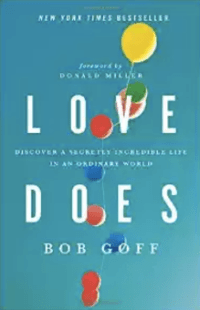
Book Review: Love Does by Bob Goff

screen-shot-2016-12-10-at-1-46-07-pmLet me just start by saying that Bob Goff, if you’re out there reading this right now, I’m looking for an adoptive grandparent. Just sayin’.

For those of you just joining us, this book has quickly moved into my favorites category in the realm of the written word. I listed to it, as per my usual, via Audible.com and was delighted to hear that Bob Goff does the reading as well. I really adored the whole thing; hung on his every word. It was too short, by the way. Need more! Perhaps a sequel…Love Does…More?

If you don’t know who Bob Goff is when I say his name, you may recall his story being included in Don Miller’s A Million Miles in a Thousand Years, another of my favorite books. Bob’s story was about the guy who helped his kids write letters to all the foreign dignitaries asking to come interview them. They received 29 yes answers and set off around the world as a family so the kids could interview these world leaders. At the end of the interview, the kids left the head of state with a key to come see them. My three sentence wrap up does it no justice, so go read it for yourself if you get the change. It’s a remarkable story. I cried and found it so inspiring. It is one of my all-time favorite stories, and it isn’t even about anyone I know! Anyway, that gives you just a glimpse of the type of guy Bob is.

Back to the book, Love Does, which is a pretty recent release and includes the same story along with many other amazing ones. I keep finding it funny that this guy is a lawyer by trade because he does so many uncharacteristically lawyerly things. He needs a TV show about his life and persona. Yes, he is a character.

The main theme of the book is about living with whimsy. He states that he doesn’t think people need more opportunities for whimsy in their life, they just need to recognize the ones that are readily available. He tells story after story about the ways he’s incorporated whimsy into his life, and consequently, the way his children, friends and family have caught the same vision.

There were two items the book instantly reminded me of when I started reading. The first is the movie Mr. Magorium’s Wonder Emporium, which is a favorite of mine. It’s chock-full of whimsy and imagination. I identify with facets of each of the characters as they strive to reconcile their own degree of imagination within a very concrete world. Some days, the skies the limit like Mr. M himself. Some days, I feel a bit stuck like Molly. And then, yes, I do have a few days like the Mutant Accountant where everything is just as it seems, and the magic has left the building. But, in the end, they each find their own opportunity to invite whimsy in, and in doing so, find the best parts of themselves and others.

The second item the book reminded me of was the book Blink by Malcolm Gladwell. Isn’t he just fascinating? I don’t think I’m smart enough to be his real-life friend, but I’d like to try. I digress… Blink is basically about the thousands of things behind-the-scenes or in the past that allow you to make split second decisions when needed. And it talks about the cognitive factors involved. It’s really amazing, as are all his books. If you like sociology type stuff, he’s great to read. Anyway, there’s this chapter in Blink where he talks about improv, and that it’s a great case study for the subject matter of the book–“making sophisticated decisions spur of the moment.” He notes that improv isn’t chaotic and random, as those terrified of being asked to do it might seem, but instead it does follow a set of guidelines that are agreed up and rehearsed to an extent, before the actors take the stage. The most important rule for improv is agreement. Meaning, you say “yes” to whatever the situation and circumstance. You don’t stop, or block it. You catch it and move forward, as they said like basketball. “Good improvisors develop action,” said one of the performers from the group Mother in NYC. Malcolm pointed out that in real life, we tend to stop action. Probably 90% of us or more would never agree upon the first rule in the beginning, and therefore, improv becomes a type of stage performance rather than real life.

I think Love Does is an answer of sorts to what good improv could look like in real life. Allowing your mind to recognize whimsy is the first step. The second is the acceptance of it. The third is the action upon it. Oh, the places we’d go–Dr. Seuss would be proud! I know for those of you straight-laced sorts out there this probably sounds either silly or scarey, or a little of both. But I think it sounds exciting and adventurous. And really, who doesn’t need more of that? Whether we recognize it or not, we’d all do a little better with a bit more adventure.

One of my favorite trips was in college with my best friend, Heather. It was coming up on Memorial Weekend, I think, and it seemed like everyone we knew was headed out of town. We didn’t want to be left on campus by ourselves so we made the decision to leave for Colorado the next morning to go see a friend. We were really giddy, got to packing, and the next morning jumped in the car ready for the road ahead. As I started the engine, I eagerly asked, “Ok, so which way do we go?” Heather replied, “I don’t know. Do we have a map?” Love it! We just started laughing, and had to postpone our trip by about five minutes so we could Mapquest our way to Denver. But the excitement overtook us, and that is a delicious place to be. (The whole weekend was great, by the way.)

Even before reading this book, I’ve been influenced by this type of philosophy over the years through various avenues and people. I’m sort of prone to it, built for it, and sought out by it, though. I wish I had room here to tell all my stories of whimsy. There have a been a number of them, and even if all didn’t turn out the way I want, they make for great memories….and sometimes lessons learned.

But I realize not everyone is automatically cozy to the idea of whimsy. I say, just start small. Try one morsel before a big bite. I think you might get hooked. After all, calculated risk still involves risk. I know you can do it! Loosen those straight laces. I don’t think you’ll regret it. And if you do, it may just mean trying again. One fail doesn’t mean the whole project is a failure. It is worth letting some playfulness in.

I think Grandpa Bob just accentuates the fact that life is meant to be lived. Sure, there are responsibilities that you’ll still have to manage. But whimsy may just be five minutes in the beginning. You can still pay bills and get the laundry done and drive the kids to soccer. Bob Goff is a lawyer, nonprofit founder and Consul General to Uganda, for goodness sakes. If this man can take time for the whimsy, we all need to take a page out of his book. Literally, I’m taking the page with the kids writing world leaders. It taught me a lot.

Read this book. You’ll definitely laugh. Definitely cry. Also I hope you gain a wee bit more respect for whimsy and, in return, start a significant relationship with this little gem.

Just remember, I asked Bob to be my adoptive grandpa first.


(Note: Amazon links are affiliate links.)


Leave a comment

Appreciating “The Process”

screen-shot-2016-12-10-at-1-54-25-pmI’m a bit of a nerd when it comes to movies. I don’t watch them for the entertainment value, though I do enjoy them at times simply for that reason (my guilty pleasure dance movies, for example). But this business of show is one that I wanted to work in for a godd part of my life, so the appeal to me is more than the final product. I love the process. And when I watch a movie on screen or at home, I see the process. I appreciate everything that went into it. I look for themes, appreciate the beauty of the cinematography and lighting, listen to the writing come to life, marvel at the effects and pull out truths. And if you’ve ever been to the movies with me, you know that I typically sit through the credits afterward (and arrive promptly for the trailers and pre-show trivia). I watch the credits for a couple of reasons. One is that it lets me reflect on what I’ve just seen. They’ve given me the appropriate music to sit there and contemplate or discuss the things I liked, and maybe didn’t like. The second thing is that I want to recognize all the people that contributed to the film. I read the names of just about everything I can, not just the celebrities. I know they all played a role in the process of getting the film to me, and I’m thankful (usually). We’ve been on this journey together, and we’ll finish together.
Over the past week or so, I’ve been watching one of my all-time favs, The Lord of the Rings trilogy. I watch it at least twice each year, sometimes up to three or four times. I can’t get enough, and at the end, I’m always ready to start it over. I think it’s just a brilliant piece of movie-making on so many levels. Sometimes I watch just the movies, but sometimes I watch all the special features, too. I bought the Extended Edition on Blu-ray on Black Friday, so that gives me…over 27 hours of special features and footage. Nope, that doesn’t include the movies. Add in another 11+ hours for those. I can honestly say I get just as excited over watching the special features as I do the feature films. I laugh, I cry, but mostly I’m amazed. I appreciate the process. There are no words to describe the thought and detail that went into this trilogy. You can see how much the people love the books, and therefore, tried so hard to honor them. It is inspiring to me. I could never catch it all, even after having watched the special features a couple of times. And I love that.

In watching them this time, I started evaluating why I love the special features so much when so very few comparatively would dare (or care) to watch them all. I’m not a big Tolkien fan, though I think his work is astounding. I know it’s sacrilege to some to say this though, but I prefer the movies to the books. I’m a movie person, though. A filmie, my friend Daron calls me. But half of the reason I love these movies is that I love the special features. And in that, I love the process.

As I starting relating it to me and my life, I had a thought. I am, and I think this applies to many of us, always concerned about the beginning and the end. Sure there are always twists and turns in the middle, but mostly I want to know where something came from and where something ends. For example, I’m overly concerned about where I’m headed in life. (I still don’t know yet so don’t ask.) Where I am is always setting the stage for what’s next. I want to know what’s ahead for me, especially when times are hard. I don’t always appreciate my process. It’s hard, it’s tiring, it’s frustrating, it’s…not always fun. And I love fun. You can also take the prime example of a female like me. When she’s single it’s, when will she date? When she’s dating it’s, when will she get married? When she’s married it’s, when will she have kids? Sheesh. Let the woman enjoy one stage for a moment, will ya! I hear these remarks all the time from friends, females and males alike rather frequently. It’s never enough to be where you are. It’s only about where you’re going next. And frankly, that’s a shame.

Let’s take a lesson from my friend, Sam.

LOTR, for me, isn’t about the creatures or the monsters or the wizards or the hot elf who’s handy with a bow, it’s about the truths that I relate to and the process of storytelling. This scene, Sam’s speech, is my favorite in the entire series. It was sort of a last minute addition from the writers to tie up some loose ends and add some closure. I think it’s so beautiful. I watch it multiple times when I watch the movie, and tear up every time. I think it’s such a lovely description of not only life, but my Christian faith. (Yep, I tend to be a bit dramatic.)

We are living great stories, ones that really matter. And stories have a beginning, middle and end. (Note: otherwise you’re telling it wrong, Michelle.) The middle is the detail. Sure, sometimes that can be tedious, but it shapes and adds greater significance to the beginning and end. The middle is what makes us who we are. It gets us to the end. To forget that is to forget ourselves. That’s what happens when we’re “too small to see it” as Sam says. We can easily want to ignore the middle because it’s where we’re living, and not always where we want to be. But there are important lessons there, and to miss them is a tragedy. It could just be the plot twist we’ve been looking for.

My friends and I, and my favorite authors and workplace for that matter, talk about living great stories. That doesn’t mean you necessarily have to go cure AIDS or move to Africa or acquire a fortune. It could, but it doesn’t have to. It simply means recognizing where God has you and doing the best you can with it. He’ll take care of the rest. He’s given you what you need to be right there at that moment. It may not always be to our liking, but there is greater purpose it in. I truly believe it. He has placed me in His narrative for a reason. That’s a tremendous thought. He. Has. Placed. ME.  It may not be for one job or one person or one calling or even one phone call, but it’s all mine because He destined me to be here. And I want to make the most of every opportunity He gives me, large or small, beginning middle or end, because He thinks I’m important enough to take on. It’s given to me. My responsibility, and my privilege.

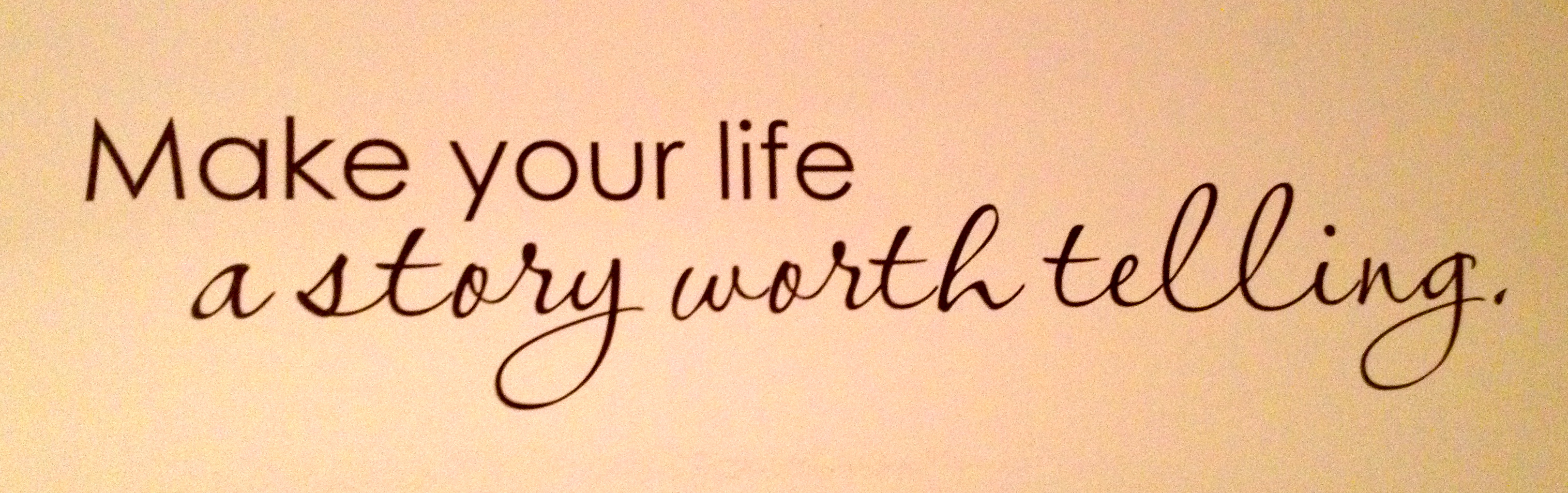
The above is a picture of a decal from my bedroom wall. I see it at least twice a day, when I get up and when I go to sleep. I wanted it that way to remind me over and over again, since I can be a little stubborn (no comments, please), that my story is important. It sure doesn’t always feel that way, but I know in my heart and my head that it is. And it reminds me that the middle of the story is where life happens. And I truly do want to live a story worth telling, but takes a lot of work every day. Little by little. Sentence by sentence. Sometimes word by word. But in the end, it’ll be a heck of a story because I won’t skip over the parts that made me sad or uncomfortable. Those parts add punctuation to the highlights. They are mine, and want to do them justice.

The process is just as important, or more so, than the ending. The final product didn’t just happen. It was often painstakingly pieced together from more details than we’ll ever know, from more people than we’ll ever realize. It’s a mosaic, a tapestry, of what living is all about.

Appreciate the process. It’s the only one you’ll ever have. And tell someone the story of your life, taking lots of time in the middle. And remember, you’re not done until you reach the very end. (Hint: if you’re breathing, you’re not done.) “There’s room for a little more” as Frodo says.

PS – I’m sure more LOTR posts are in my future, but if you’d like to read my lessons learned from them in 2009, here they are: one, two, and three.

(Note: Amazon links are affiliate links.)