If you aren’t familiar with Jen, you need to become part of the fold. She’s funny and smart and honest, and most of us regular Christian gals just wish we could be friends with her. Jen’s most popular book, 7: An Experimental Mutiny Against Excess, is one you may be more familiar with. It was where I first formed my girl crush. Or if you are an HGTV junkie, you may know her from My Big Family Renovation.
So, she recently re-released Interrupted, and I thought that now was finally the time for me to read it. Soooo glad that I did. It is an inspiration to me for sure, and maybe it will be for you too.
It tells the story of her entry into social justice, and consequently, how she and her husband, Brandon, formed Austin New Church. Her story resonated with me on so many levels. We grew up in church, lived pretty comfortable lives, did lots of ministry work, worked our way toward what we thought was success . . . and were still left believing that, even though life was very good, there had to be more to this life of faith. We were both sort of blindsided with social justice, but now see it as a calling and glad it has wrapped itself around our hearts.
If you are a Christian and at least curious about social justice on some level, I highly recommend this book. It’s a great starter and entry point. She does a beautiful job of laying out scripture on social justice, and telling you of her struggle to basically allow God to interrupt her very comfortable life for this new venture. She could’ve say no thank you, but she chose to see God’s leading and embraced it. She lived a life many of us are familiar with, and may need to question in one way or another. She prayed a very simple prayer, and it changed everything. So, let that serve as your warning. 🙂
And even if you are a seasoned social justice advocate like me, you’ll love this book. For all the reasons that I’ve already outlined, and so many more, you’ll find a kindred spirit on this journey. It’ll remind you of where you started, and more importantly, why. And it’ll inspire you to continue your great work. On the days when it feels lonely and hard, you’ll remember you’re not alone.
So, check out Interrupted. Just be prepared for what may come next.
I was reading the book of Ruth the other night. The intro talked about Ruth being full of everyday miracles. “God usually works in the ordinary events of everyday life. Miracles do happen, but God regularly accomplishes His purposes and blesses His people through routine occurrences. If we learn faithfulness in the everyday, we are equipped to be faithful when the miracle or crisis comes . . . The everyday and the ordinary can have breathtaking eternal results.” (NLT Study Bible)
Overall, Ruth is a pretty ordinary story, especially when compared to the plagues, tumbling walls and fire-consumed altars all around her. But God is there. He is always there, whether we see or feel Him. Perhaps that’s why so many find comfort in this book. It’s a good reminder to find God in the everyday-ness of life.
Most of life is lived between big events, but there’s still plenty worth celebrating or at least noting. He created us to live fully, and that means the in-between as well. You and I friend, and loads of others, are living in-between what we want our story to be about, what we want to be known for. The days are made up of errands, laundry, bills, work, too much television, long commutes and trying to see all the Oscars Best Picture nominees. (Just me on that last one?) But books aren’t comprised of just a first chapter and last chapter. There are all the words and phrases and sentences in between, sometimes beautiful and sometimes sorrowful, and we can choose to live them or skim over them. We can boldly add more exclamation points, or resign to suffer more footnotes.
There will undoubtedly be days that we just skim by. And that’s okay. Neither of us is perfect. But I pray we will live every syllable with the freedom we have been given.
I read some great books this year! I didn’t surpass last year‘s number, but I sort of also rediscovered listening to music for a couple months. Still, I guess 28 books isn’t too shabby.
A lot more fiction has seeped into my reading list the last two years, which still kind of surprises me. But Audible just makes it so much more easy to fit books into my schedule, and enjoy them, so I’m welcoming it.
I was sort of in a “classics” mood this year and tried to also do A Tale of Two Cities by Charles Dickens and The Adventures of Huckleberry Finn by Mark Twain. Um, maybe I’ll revisit them in the future, but they’ve been abandoned for now. Is it me, or is Dickens hard to read outside of A Christmas Carol? Will I have better luck with David Copperfield (book, not magician 😉 ). And I remember liking Tom Sawyer, so maybe Huck’s just not for me. Or maybe I’ll just stick to the movies and plays.
Anywho, this is the list of who had my ear the past 12 months. What about you? Anything I should add to my 2015 list?
This is a repost of a blog I did last year about this time because it’s a message that still resonates strongly with me, and I hope it will with you too. May your holiday shopping be full of hope and happiness for all.
A few months ago I read Pursuing Justice by Ken Wytsma. I wasn’t expecting the book that it turned out to be, but it was still very good. It sort of turned out to be a Bible study on justice. I would definitely recommend it, and not just for those passionate about the issue like me, but even for the mildly curious. I learned a lot and will be marinating on it for a long time to come.
There were a few things mentioned in the book that stuck with me, but none more than what I wanted to share with you now. Did you know that it costs approximately $21 billion to get clean, safe drinking water to everyone in the world? If you weren’t aware, almost 1 in 7 of the world’s population doesn’t have access to this most basic need. $21 billion. I know, right, it sounds like a lot—like a whole lot! It sounds like scratching our heads and calling summits and raising money and finally reconciling ourselves to the fact that $21 billion is impossible to find in a world drowning in debt. Sometimes it sounds like giving up.
And then I found out…
The National Retail Federation estimates that over $600 BILLION will be spent in November and December this year. I’m sorry, what? That’s just this season. When I think about it, that makes me sick. In fact, the contrast in those two numbers has literally haunted me since I’ve read the book.
I think about people I know that rush around trying to buy gifts, any kind of gifts, for the people on their Christmas list. Mostly those are close family and friends, but usually there’s at least one obligatory gift on there as well. I think of gifts that aren’t bought out of need, but out of courtesy. I think of the stress so many people feel when it comes to the holidays. It seems to be more about putting anything under the tree that caring about what it is, as long as you’ve checked that box.
Something. Has. To. Change.
I love the holidays. I love the chill in the air, and the warm drinks. I love watching Christmas movies. I love decorating my apartment. I love seeing twinkle lights go up everywhere. And I love buying gifts. Gift giving is one of my love languages. It makes me happy to see the look on people’s face when I give them a gift. In fact, the anticipation of seeing their faces when I give them the gift makes me happy! I have always tried very hard, whether it’s a birthday or Christmas, to find the perfect gift that will make the recipient smile. It’s a challenge that I relish.
And, if I do say so myself, I’m pretty good at it. But the last few years, ever since pursing justice myself and learning more about supply chain and slave labor, I’ve tried to challenge myself in a new way. I try very hard to find not only gifts of meaning, but gifts that do good or do not perpetuate slave labor. I’m also an environmentalist, so I try to cut down on packaging and reuse when possible. So, really, I thought I could pat myself on the back from up on my high horse—until I read those statistics.
Now I’m trying to figure out how to do more. I can’t completely give up gift-giving, because I love it so much, but there is more I can do. For one thing, I can help educate you. What if we all started buying differently? What if we started contributing more and consuming less? What if we took a hard look at the real difference between shopping and giving? What if the presents had real meaning, not just for the recipient you know, but those who created it or will benefit from the purchase? What if?
Here is an awesome video by Advent Conspiracy to help illustrate. In fact, they have a lot of great personal and church resources to help you explore this idea. I’m looking forward to reading their book this season.
As I said, I don’t have this all figured out, but I’m trying. I want to contribute, not just consume. I want buy better and think better and live better. And even more, I want that for everyone else. I want it for you, and those you know, and those around the world who don’t have clean water or adequate shelter or who live in fear. We all share this world.
The holidays are a season of hope. Hope, joy, peace—we see those words written on everything this time of year from cards to commercials. What if they weren’t just platitudes? What if we added those to our Christmas list? What if, when we started buying gifts, we kept those three words in mind? Will the things we buy this season promote hope or joy or peace? If not, then let’s not buy them. Find a better alternative. I bet there’s one out there.
There are so many more, though, so keep looking! And if you need to go the department store route, you could even institute your own TOMS-esque one for one model. For example, if you give someone a shirt, donate one as well. Challenge each other to be better, think creatively and give more.
Give gifts that tell stories, and write yourself a new one in the process.
______________________________________
And here’s a great article from the TODAY Show about families who try to put more meaning into gifts and the holidays.
Here is another from LearnVest, a money budgeting site if you’re looking for a more frugal point-of-view.
One more from journalist/activist, Nick Kristoff, whom I greatly admire.
DID I MISS YOUR FAVORITE RESOURCE? PLEASE ADD IT IN THE COMMENTS SECTION! I’D LOVE TO HEAR ABOUT IT.
If you like social justice, you’ll like these books. If you are the teensiest bit curious about the origins of your food or clothing, you’ll like these books. If you like to learn, you’ll like these books. If you like to read, you’ll like these books. In short, a lot of people should give these books a good read.
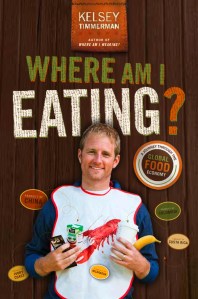
I’m not quite sure how he did it, but author Kelsey Timmerman has done a smashing job of blending information and humor with an overall narrative you want to continue long after you’ve put the book down. I loved both of these books, and have recommended them to a mess of people since reading them.
In Where Am I Wearing?, Kelsey travels from Honduras to Bangladesh to Cambodia to China to find out the genesis of his favorite clothes: jeans, boxers and flip flops. He takes you through the process of tracking down where his clothes are made, and then into the factory themselves. He speaks to the workers both on the jobs and in their homes.
In Where Am I Eating?, his follow-up book, Kelsey explores the humble beginnings of his family’s favorite and most common food and drink. His adventure takes him to coffee fields in Columbia, a cocoa plant in Ivory Coast, a banana plantation in Costa Rica, a lobster boat in Nicaragua, and the apple orchards of Michigan (via China).
Both books are completely eye-opening. I definitely had some thoughts, opinions and preconceived notions going into these books. And they changed me. I thought I was doing a pretty good job of researching supply chains (the process by which goods are made), but Kelsey helped me go deeper. Now, I must admit there are some areas where I have more questions than I’d previously had answers. But I believe I have also created some better habits. If these books do one thing, besides make you laugh, they’ll make you think.
I’ll give you two examples:
I was Miss Western Culture holding up my picket sign for “No Child Labor!” before Wearing. But, his book makes you realize that there is so much more to the face, however young, of the issue. It’s a systemic issue, not fixed over night by the banning of goods or mandates set by those on the other side of the world. In cultures where it is normal for kids to work because the adults have already passed their prime, families could starve. Well…that’s not an outcome I want either. There are layers to this issue. I don’t like it, but they’re there. There are so many things that need to happen in those societies before/during/after children are pulled from the work force. Mindsets have to change. Hearts have to change. And people fear change. So, what am I to do? You know, I am still not 100% sure. I know one thing that has to happen is that I have to be informed. So, I learn and I research, and I make the best choices I can with the information I have. And that’s where I’ve landed…for now.
I used to work at an eco-organization, so I thought I had a pretty good handle on food supply. I know what harsh chemicals are used to grow and treat food, and what we label “food” which could more adequately be described as a science experiment. So, I thought I was ahead of the curve on this one. But again, I realized how short-sighted I had been. It made so much sense when reading it. It felt more like a “duh” moment than an “a-ha” moment. And that was because I’d been buying regular produce for thick-skinned items because the chemicals hadn’t reached the food. I’d buy organic for thin-skinned because they were treated with chemicals. Well, despite my efforts and proclamations to be a good global citizen, I’d completely neglected that the people working in the fields with the thick-skinned items (ex: bananas) had been doused in chemicals. I hadn’t given them a whole lot of thought. But I certainly don’t want anyone to be harmed in the process of getting food to my table. I want to know that these items improve their lives, not send them to the hospital or lead them to an early death. So, what do I do now? I buy organic and local as much as I can.
You may be reading this thinking that it’s all well and good for me, but it costs a lot of money to buy organic or a lot of time you don’t have to research clothing. And I get it. I do. I was there once upon a time. But friends, ignorance isn’t bliss. I know the decisions I make when I purchase impact others, and I want those to be good decisions. I do the research and I buy organic because I have personally made it a priority. We all find time, energy, effort and money for the things we decide to make a priority. That’s a fact. Start small.
This is not a guilt trip. It’s just an attempt at a conversation I feel needs to happen. Like I said, these books are funny and honest. Kelsey doesn’t set out to provide you answers and three steps to better buying decisions. He is curious, and he takes you along for the ride. You’ll feel like he’s a friend by the end. I honestly think you’ll want to be a part of the conversation after reading these books. (By the way, Kelsey is very active on social media, so yes, you can actually have a conversation with him. He’s awesome.)
There is good news, however. There are more and more companies who care. I think by making these more informed decisions, we are telling businesses that we want to see more ethical production take place. And I think that’s the best way to move forward.
Besides Kelsey’s books, here are some other resources to get you started:
Free2Work (Website and App: The website has reports on clothing, coffee and electronics)

 I just finished reading Jen Hatmaker’s book, Interrupted: When Jesus Wrecks Your Comfortable Christianity, last week. Ummm, pretty FANTASTIC!


 In
In  Mental Post-Its