I’m excited to be heading to The Yellow Conference this week! It’s my first time at this event, which is dedicated to creative and entrepreneurial women. And as an added bonus, it takes place in my self-adopted second home of Southern California. Should be an awesome event!
This is a conference I look forward to every year. It’s fun, I’m able to see old friends, and it’s locally-focused. The last item is what makes it truly unique. The people who speak are not only inspiring, but most often, they’re doing something remarkable in the Atlanta area. So, while I love hearing big names from big companies, Plywood is really awesome because I can also usually say that the speaker or company is just miles away from me. It gives me plenty of chills and warm fuzzies.
19 million orphans in the world, 500K in US foster care, 25% of kids who age out of the system are homeless, 80% in jail, 30% are pregnant, 80% end up in prostitution and 56% wind up unemployed. The system is seriously failing these kids.
Family is the answer to almost everything.
Lots of organizations are doing great things, but they are all working piece-meal instead of in concert.
Barriers to adoption are finances, information and community.
Adopt Together allows micro financing for adoptions.
We must care for the spark of divine in ourselves.
Love may be a slow process, but it’s always worth it.
There is power in peace.
There is a price to be paid for the work of peace. You must decide if you’re willing to pay it.
Without music, the Civil Rights movement would’ve been like a bird without wings. We’d often sing to each other across our cells, both men and women, because we were separated by both gender and race.
When you see injustice, make a little noise. Don’t stay silent.
When I was younger, I never would’ve imagined that I’d become a person with ongoing stress, anxiety or sleep issues. Then I hit my 30’s, and was introduced to this terrible trio. And instead of having a steady, committed, long-term relationship with sleep, we became more casual friends, and sometimes acquaintances. We started drifting apart. I think on several occasions it even became that person that you think might be your friend, but doesn’t acknowledge you in a public place so then you’re not sure. Yeah, we have our issues.
Sure, I’d known stress and anxiety before, as part of being a perfectionist, but it wasn’t something that stuck around for very long. And to be honest, I’m not entirely sure what triggered the sleep issues. That was the first, and started happening early in my 30’s. The others were mostly results of high-pressure jobs that I’d had, I think, but probably combined with other things too. But they all started hanging around like leeches thinking that I owed them something before my chronic health issues of the past four years, that’s for sure. And they’ve certainly worsened with the decline in my health, because I can’t handle them as effectively as I would if I was healthy. Things get to me more easily. They take longer to sort through, and irritate me more . . . which, by the way, doesn’t help. #Cycle And my personality is one that just has a harder time letting go of things. We are big feelers with long memories.
However, one of the things I find most fascinating about humans is our ability to adapt. So, like any representative of my species, I’ve found a few ways to cope:
The Five Minute Journal (also an App): I am not a negative person, but I am a perfectionist, so being critical is something I struggle with. I use this journal every morning and evening to take stock of moments of gratitude and highlights in my day.
Essential oils: I personally love and use doTerra. I have many favorites (Breathe), but for tackling this issue, I’m all about Balance. I diffuse it or put it directly on my skin when I need it’s calming benefits. Just reaching for the bottle makes me feel better.
Supplements: I get these either directly from, or recommended by, my naturopaths. I currently have one to help with anxiety and one to help me sleep that I take periodically. I think they help a little, but they’re still new to me, so I’m evaluating. But, of course, they aren’t the only things I’m doing, and I think that helps.
A sleep mask: My first one is pictured above, but I have this one now. When I first started having sleep issues, I tried all kinds of things. I never thought I’d like a sleep mask. I always thought of them as making me kinda claustrophobic. But I was at my end, and gave it a try. And loved it! I’ve been using them for years, and also have a separate one that lives in my luggage for travel. I don’t think I could sleep without it now.
Calm meditation app: I did several free trials of apps, and had it down to this one and Headspace. In the end, I liked them both, but this was cheaper. I like the sound of the waves, as well as the woman’s voice. I’m not practiced enough to do it on my own yet, so I like the guided meditations. And yes, they do have them for stress, anxiety and sleep. I’d wanted to start meditating this year already, so these blended together well. I try to do it for 10 minutes in the morning and 10 minutes at night.
Walk outside: I usually love nature from a distance, but I really do love to walk outside, especially on a trail or somewhere to shield me from the city a little. We also have beautiful mountains in Georgia. I find these walks really calming. I listen to an audiobook, or podcast or pray, but usually a mix. I definitely feel a sense of restfulness and renewal, not mention accomplishment, afterward.
Friends: I spend time with people who fill me up. This usually means grabbing coffee or a meal or frozen yogurt. I hate talking on the phone, so that’s usually my last resort, or if the friend lives far away. But there is just no substitute for a good conversation with an even better friend.
Mentor: I never knew I needed a mentor until I had one. I sort of stumbled into it with a group of girls and two women about 10 years ago. That lasted for about two years, and was awesome, but we all moved on. Then I spent another couple of years trying to find a new one, and was introduced through a friend. My mentor Holly and I meet about once a month, and I guess it’s been about six or seven years now. She’s awesome, and advises me on all kinds of things from business to personal. I’m currently looking for a new business mentor as well. Holly has mentors for different areas of her life she wants to improve in, and I think that’s really cool.
Movies: I love TV, too, but sometimes I need the “away” that a movie in a theater brings. It’s a quick escape, super enjoyable, and only takes a couple of hours. I have a deep love for movies on many levels, and this is certainly one of them. I actually just rewarded myself with the new Star Trek movie last Friday morning after a stressful work week.
One to grow on! Candy Crush: This is a weird one for me. I’m not really one to play games on my phone, but somehow I started doing this one at the beginning of the year when I had a full-on anxiety attack. I play it because it helps me focus on one thing at a time. I don’t have the flood of emotions and thoughts while I play this. I’m sure other games do the same thing that take strategic thinking, but this one works for me.
I know a lot of people would add pets to this list, but I am too selfish, cheap and OCD to have my own pets. I enjoy other people’s pets from time to time and that works just fine for me.
I will also, for good measure, throw depression into the mix here as well. Though I’ve struggled with it much, much longer. I will also lump my own depression and anxiety here because they often don’t look the same as what is usually portrayed. I didn’t realize I had depression for a long time because I wasn’t sad, therefore, I didn’t know the way I lived was any different from anyone else. Depression is more of “a lack” for me. I just feel less than myself. Kinda like a dull, rather than shiny penny. And I definitely get Seasonal Affective Disorder, which is one of many reasons I’m always considering moving to Southern California. Likewise, full-fledged anxiety is new for me, and thank you God, I’ve only experienced it a couple of times after it developed this year. More often, my anxiety is very mild, mostly resulting in a flood of thoughts when my mind should be still, like sleep. It’s nothing very emotional. Usually just t0-do lists and things like that. I love lists. But, of course, these things do contribute to a larger overall picture.
Side note: I will also say that I believe these kinds of issues, especially depression and anxiety are more common to creative, feeling people. I keep asking my friends who study psychology to do papers on this! It’s nothing formal I’ve found, just my own research through my experiences and conversations with others. And the worst part, especially with depression, is that it makes you feel very isolated, like you’re the only one who’s living a less than ideal life. If that’s you, I’m so sorry, and I’m here to tell you that you aren’t alone.
And yes, I do also have a prescription for Ambien, and take it occasionally, especially when I travel. I do believe there is a time and place for traditional medicine. But I try to take the more natural road when possible to put better things in my body and have less long-term effects or dependency which I believe come from many medicines. I know I am luckier than some in that I haven’t handled these issues with stronger substances, or been consumed by them. I’m incredibly grateful for that.
And I’d like to say that these 10 things work without fail every time, but that’s not true. I started writing this blog post in my head at 5:00 a.m. this morning, practically the middle of the night for me, and finally got out of bed to start writing it a little after 6:00 a.m. So, tonight, I try again. But by in large, they’ve been very helpful and allow me to lead a more normal life.
If you deal with any of these issues, how do you handle it? I’d love to learn from you, and keep adding to my list!
PS: Dear, sleep – I thought we had a good thing going. I don’t know what I said or did, but I’m sorry. With all my heart, I’m sorry. Please come back to me.
I was excited to visit the MLK Memorial in DC last fall.
One of my favorite passages of scripture is 2 Corinthians 5:11-21, particularly the part about God giving us the “ministry of reconciliation.” To me, that is central to the work of social justice. It is a mantle I have taken up, and carry with me. And it is what comforts me when I’m weary of how people have harmed each other over and over again, but feel the need to take a step forward anyway.
I once heard someone define justice as “God’s way of putting things right,” and I liked that. It makes the word both a noun and a verb, and I believe that’s how we need to treat it to make any real progress.
11 Since, then, we know what it is to fear the Lord, we try to persuade others. What we are is plain to God, and I hope it is also plain to your conscience.12 We are not trying to commend ourselves to you again, but are giving you an opportunity to take pride in us, so that you can answer those who take pride in what is seen rather than in what is in the heart.13 If we are “out of our mind,” as some say, it is for God; if we are in our right mind, it is for you.14 For Christ’s love compels us, because we are convinced that one died for all, and therefore all died.15 And he died for all, that those who live should no longer live for themselves but for him who died for them and was raised again.
16 So from now on we regard no one from a worldly point of view. Though we once regarded Christ in this way, we do so no longer.17 Therefore, if anyone is in Christ,the new creation has come: The old has gone, the new is here!18 All this is from God, who reconciled us to himself through Christ and gave us the ministry of reconciliation:19 that God was reconciling the world to himself in Christ, not counting people’s sins against them. And he has committed to us the message of reconciliation.20 We are therefore Christ’s ambassadors, as though God were making his appeal through us. We implore you on Christ’s behalf: Be reconciled to God.21 God made him who had no sin to be sinfor us, so that in him we might become the righteousness of God. (NIV)
These verses have rung loudly in my ears the past few days as we heard yet again about the tragic shooting of two African American men, compiled with the devastating addition of the attack on police officers in Dallas. Both are heartbreaking situations that never should have happened. But the question remains, what are we going to do about it?
I honestly think many people just don’t know what to do. It’s not that they don’t care, but they feel stuck in their response. Or maybe they feel conflicted in what to say, or how to react, or where to turn, or simply how not to offend. I’ve felt some of that myself, and I address it a bit here in this guest blog post.
So, if you can relate, I’d like to provide you with just a few resources that I hope will be helpful.
The first, of course and as always, is to pray. My friend Latasha started a terrific organization called Be The Bridge, which promotes racial unity and reconciliation through conversations and the Church. I suggest looking through her resources and site. But her first piece of advice for anyone is to pray. Pray for the situation. Pray for your personal response. Most of us live in our own bubbles, complete with people who look and think like us. So, pray for opportunities to make new friends or have these conversations with old friends. I think these are requests God would love to honor.
Another thing Latasha suggests is reading books by people who look and think different than you. Additionally, follow these kinds of people on social media, or go to the places they hang out.
Continuing along these lines, here is a fantastic conversation by Latasha and IF:Gathering founder, Jennie Allen, that took place on Friday. I highly recommend this 45-minutes as its just an honest sit-down between two friends.
This is a great article by Relevant Magazine for understanding the #BlackLivesMatter movement.
Check out this article by Kristen Howerton, who is white, which explains the concept of “white privilege.”
There are also many terrific books and movies as well. Two books I’ve read in the last year are The New Jim Crow: Mass Incarceration in the Age of Colorblindness by Michelle Alexander and Just Mercy: A Story of Justice and Redemption by Bryan Stevenson. And I gotta say, the latter is one of the hardest and most beautiful books I’ve ever read. As far as movies, there are well-known ones like Life is Beautiful and American History X. Here are a bunch more, and it wouldn’t take much research to find others, or you can ask me for more. I have lots to catch up on in this area too, and have books piling up in my Audible Wish List.
Pardon the bleeping, but this The Daily Show clip does make some good points while also bringing some humor to the situation. It’s always good to infuse some humor when you can.
There are lots and lots more, but if you need a starting place, hopefully this will provide you with one.
But here’s your disclaimer: I’m telling you now that this can be a messy process. I know that sounds scary, but it doesn’t have to be. If you’re getting outside your comfort zone, which you should in many aspects of life, just remind yourself that you’re doing it to become a better person and more educated. Most often, the people who don’t look like you will be really grateful that you’re making an effort to see life through their lens. And grace will be extended on both sides. Just make a new friend. You’ve done that before. You don’t have initially start with a race conversation. In fact, they might appreciate that too. 🙂
Sadly, I have seen bigotry in action. I have witnessed an actual segregated community south of Atlanta, complete with the literal “other side of the tracks.” I have heard friend’s stories of how they were discriminated against. And even if you missed these things, you’ve probably heard jokes that come at someone else’s expense. We cannot keep pretending these are ok. We cannot keep silent. This kind of harmful thinking often starts in small ways. And therefore, small actions can create change.
When you know these people, not just know of them, you should want to fight for them.
It’s hard work. It’s ugly work. It’s messy work. But it work that matters. And if you follow Christ, you have also been given the ministry of reconciliation. So, what are you going to do about it?
“In a real sense all life is inter-related. All men are caught in an inescapable network of mutuality, tied in a single garment of destiny. Whatever affects one directly, affects all indirectly. I can never be what I ought to be until you are what you ought to be, and you can never be what you ought to be until I am what I ought to be… This is the inter-related structure of reality.” ― Martin Luther King Jr.’s Letter from Birmingham Jail
UPDATE on 7/12/16
I’ve also just watched these two online sermons from this past Sunday, and they’re additional great examples to watch about how the Church can address the issue.
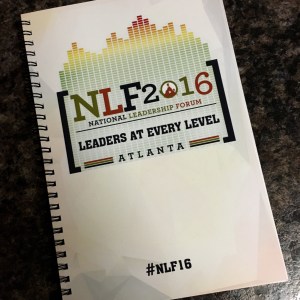
Last week I had the privilege of attending the National Leadership Forum. My mentor Holly is the COO of Growing Leaders, who hosts this unique gathering, and this is the second time I’ve attended this fantastic event. It’s geared toward educators, administrators, coaches, and mentors, and even though I am none of those things, I still learned a lot with the theme of “Leaders at Every Level.”
If you fit any of those categories, I’d urge you to make your way to Atlanta next summer. But it will probably sell out, so plan early! And this would be a great excuse for those of you who have ongoing education budgets at your disposal.
Here are some of the gems I picked up during these two days:
Tim Elmore
The leader of the company is the crafter of the culture.
Why do we fail to develop leaders:
The busy myth. We claim we’re too busy and don’t have time.
You must schedule your priorities.
The treasure hunt myth. We hope we can just find and hire them.
The reproduction myth. But we’ve never been equipped ourselves.
We teach what we know, but reproduce who we are.
The maintenance myth. We’re satisfied with just plugging holes.
When an org or school fails to develop good leaders:
It’s a failure of systems.
It’s a failure in culture.
“When a flower doesn’t bloom, you fix the environment in which is grows, not the flower.” – The Vibrant Mind
Common org cultures:
Toxic culture
Distant culture
Fun culture
Confused culture
Stagnant culture
Blind culture
The truth about culture:
All teams have a culture, by default or design.
People are carriers of culture, good or bad.
“Let’s hire the culture we want. Gifts can be cultivated.”
Some teammates are more contagious than others.
There are as many cultures as there are managers.
The culture affects behavior more than anything else.
“Culture eats strategy for breakfast.” – ?
A leader’s job is to cultivate a healthy culture.
Build a healthy culture and it will grow.
They do this through their habits and attitudes.
The ultimate job of a leader is to create more leaders. They do this by building a system and culture.
Hanging on the wall isn’t necessarily what’s happening down the hall.
Your org is telling a story…not unlike a movie. And it has a soundtrack. You have:
A script (your words)
Acting and blocking (your behavior)
A sound track (your culture)
What’s yours? Did you write it or let it happen?
It can make or break the movie.
Like your culture, the sound track provides the feel of your story.
If we’re not careful, our sound track can ruin all we’re saying and doing. (ex: Ms. Doubtfire cut to be a horror.)
If we’re intentional, our sound track can enhance all we say and do.
At Growing Leaders, we’re intentional about:
Mission and values
Vision and objectives
1% can change the 99% (ex: MLK)
Brand personality
Tweet flavor (social media)
Inside “rules” for outside “reputation”
Our physical environment
Differentiators
Dr. Meria Carstarphen – Superintendent of Atlanta Public Schools
Brought in after the APS cheating scandal.
You have no idea how good/bad the situation actually is until you’re inside the culture/org.
Access to quality education at every level, age and zip code changes lives.
Born in Selma, AL, and family still lives there.
There are people meant to make the changes. I am that person.
Culture is usually the last change we make.
“Where the needs of the world and your talent intersect, there your vocation lies.” – Greek philosopher?
Express empathy and give people a chance. Don’t live in fear.
She is active on social media, plays with the kids, gives parents and kids her cell phone number.
Tell people when they do something right, not just when they do something wrong.
Put a succession plan in place way before you think of leaving.
Leaders should bring out the strengths of those in their care.
You can’t let sabotage stop you from doing the right thing.
And as a leader, you can’t let the sabotage into your heart and head, or it will effect your culture since it starts at the top.
Don’t wait till your kid is in school to help shape the school. Join committees and be a part of things that will help create the school you want your kid to attend.
Gene Smith – Director of Athletics for Ohio State University
Create an environment for constant communication.
People will forget what you said or did, but never how you made them feel.
They have a structured development program for everyone, and know where they want to go in their job and life.
Stay true to your values above everything else. I own my integrity.
Learn to confront in a timely manner. When you have the backbone to stand up for your values, you create respect, despite any backlash.
Make sure your people get their rest and vacation.
They call their coaches “teachers.”
Instead of calling the people listed as references, call the people below and around them to see how they’re treated. Hire for character.
Their student athletes go through trainings to set them up for life and character, not just football.
A title doesn’t make you a leader.
Never forget your custodian! They make your world go.
Holly Moore – VP of Growing Leaders
Change fatigue is real.
“Emotional sickness is avoiding reality at any cost. Emotional health is facing reality at any cost.” – M. Scott Peck
All of us have ways we take in and evaluate information.
Myers-Briggs is the DNA of your personality.
Where do you get your energy: E or I
How do you process info: S or N
How do you make decisions: T or F
How do you prefer to live: J or P (greatest cause of relational disharmony)
Insecurity in a leader is toxic.
Leadership comes with a microphone.
Five voices: Pioneer, Connector, Creative, Guardian, Nurturer
Teams should have a variety of these, and respect for each other.
Always cares for others, but can stuff feelings to make peace. Make sure you are heard too.
Guardian
Believes change is necessary, but can come across as overly critical. Look for ways to compromise. Share your feelings before your questions.
Connector
Whatever’s needed, you have a source. Great collaborators. Can become passive aggressive or withdrawn if you sense rejection. Become more self-aware when you sense feelings of rejections, and process them.
Creative
Never satisfied with the status quo. It can always be better. Communication and function bed when you know your contribution is valued. The word “can’t” isn’t in our vocabulary. Can fail to celebrate the 90% achieved, and focus on the 10% not done. Can be paralyzed by perfectionism. (F) When you’re stressed, you become The Hulk. (T) When you’re stressed, you’re a sniper. Speak up sooner. Don’t build up “retaliation rocks” or stuffed feelings. Feelings aren’t buried dead, but buried alive. Resist perfectionism.
Pioneer
Anything is possible! Visionary and courageous. But you can fail to hear all the voices, or have a “back me or fight me” mentality. Stop and listen before reacting. Find a safe place to process.
Judith J. Pickens – Senior Advisor, Youth Advocacy at Boys & Girls Clubs of America
All young people are at-risk today.
Five key elements to help kids thrive:
Safe, positive environment
Fun
Supportive relationships with caring adults and peers
Opportunities and high expectations
Recognition
Prioritize for a prosperous future:
Academic success
Good citizenship and character
Healthy lifestyles
Seven states have more than 20% of their high schools are considered “drop-out factories,” which graduate less than 50% of seniors: SC, FL, NV, GA, NM, NC and MS. Mississippi always comes in last on education surveys.
What you doing that’s life-changing, generation-changing or transformational?
Children often take their queues from their teachers and parents.
Statistics go up exponentially for the success of kids when they are connected to their world and a caring community.
“Our Kids: The American Dream in Crisis” – book by Robert Putnam
Austin Moss – Director of Player Engagement at NFL
Whatever you do, do it with excellence.
His job is to help players transition well after the game as well. Average career of a player is three years.
Works with the development of high school and college student athletes.
All employees go through domestic violence training.
NFL has different service and celebration activities.
Tim Elmore
Digging Wells Before You’re Thirsty
The need of the hour is 1) more and better leaders, and 2) a relevant equipping process to prepare those leaders (staff and students).
Trains and Tracks – Tracks may look confining at first, but they’re the path that make trains go.
Our world needs graduates who 1) solve problems and 2) serve people.
What we believe about leader development:
It’s an inside job before it’s an outside job.
It’s a process more than an event.
It’s a right-brain function before it’s a left-brain function.
It’s more caught than taught.
It’s done in small groups more than big groups. Circles not rows.
It’s more about a disposition than a position.
It’s learned through both uploading and downloading.
It’s about an experience not just an explanation.
It’s about relationships before it’s about results.
It’s about service before it’s about success.
The top-down funnel for events and activities: (creating bridges between levels and gently push them as far as they’ll go)
Attraction – Had to be interesting to people
Involvement – Getting known by others
Service – Had to do something
Leadership – Now they get to be in charge
Multiplication – Leading leaders
The Big IDEA
All great training contains four thoughts.
I – Instruction (They need conversation.)
D – Demonstration (They need it observation.)
E – Experience (They need participation.)
A – Assessment (They need evaluation.)
Tim Elmore: A Leadership Cult or Culture: Cultivating an Environment of Growth and Leadership in Your School or Organization
Josh Bledsoe – FFA COO
By 2050, the world’s population will reach 9 billion. We need to double our food supply to feed them.
Career development, personal growth and advocates for agriculture – new mission
Tim Elmore:
Cult or culture:
Cult – Leadership is all about them. (Hansen and Karish)
insecure, control issues, ego
Culture – Work that wants to live sole for something bigger than themselves.
Community of shared qualities that foster change.
Every culture possesses shared values, shared customs and a shared language.
The same can be true for org culture.
Cultures don’t change without something to gain.
The two great motivators are pain and gain.
People on a team become carriers of the culture.
A leadership culture is an environment that contagiously affects people to think and act like authentic leaders.
If you could create a culture, what words would you use to describe it? How would you describe your current culture?
“Success without a successor is a failure.” – Romanian proverb
You can only change about 20% per year in an org, and only 20% of the people will lead the charge.
You’re more likely to act out the change than talk out the change.
“Some say it is unfair to hold disadvantaged children to rigorous standards. I say it is discrimination to require anything less–-the soft bigotry of low expectations.” – George W. Bush, campaign speech before the NAACP (2000).
Ken Blanchard – Consultant, Speaker, Author
“The One-Minute Manager” – his first big book
“The Generosity Factor” – another of his books
Effective leadership is all about managing people’s energy.
Take 30 seconds to greet people like you’re looking for someone’s energy. Take another 30 to greet people like they’re long-lost friends.
Your beliefs drive your behavior. Your behavior gets you results.
Being an effective leader:
Servant – It’s not about you.
Steward – You don’t own a thing.
Shepherd – Everyone is important.
Servant leadership gets the best results.
Leadership is about going somewhere.
Mission – What you do
Vision – Where you’re headed
Values – How you get there
Goals – The means to the end
Your job is to help the people under you win so they can help your customers win.
Have employees rate themselves regularly, and the manager agrees or disagrees. The manager needs to help them try to get an A.
The end result needs to be clear, and the manager helps them get there.
Transformational leadership starts with self leadership.
Then one-on-one.
Then team.
Then org leadership.
Catch people doing something right.
“In the end, everything goes back in the box.” – John Ortberg
Are your people culture builders or culture busters? If you let the latter stay, you’re not staying true to your company values.
Wayne Hammond – Resiliency Initiatives
Stop looking at what’s wrong with people, and focus on what’s right with people.
“85% of positive change comes from being a relationship that’s meaningful to you, and talking about something that matters to.” – his friend.
Measure resiliency. (a strengths-based culture)
Help teachers learn to be coaches in the classroom.
Resiliency is a by-product of culture.
The starting point in their potential. Their strengths not weaknesses.
We medicate kids into the behaviors we’re looking for.
Girls develop fine motor skills before boys, which is what is rewarded in schools.
Listen to someone’s story, and you’ll find out what’s important to them.
Three evolving challenges: Academics, Culture, Life Skills
Resiliency helps kids navigate risk, not avoid it.
Mot kids don’t know what their strengths are.
The four phases of transformational change: Connect, Inspire, Build and Empower
When you don’t give up, you cannot fail.
“If you think our future will require better schools,you’re wrong. The future of education calls for entirely new learning environments.”
“If you think we will need better teachers, you’re wrong. Tomorrow’s learners will need guides who take on fundamentally different roles.”
“Start by doing what is necessary,then what is possible, and suddenly you’re doing the impossible.”


 This is a conference I look forward to every year. It’s fun, I’m able to see old friends, and it’s locally-focused. The last item is what makes it truly unique. The people who speak are not only inspiring, but most often, they’re doing something remarkable in the Atlanta area. So, while I love hearing big names from big companies, Plywood is really awesome because I can also usually say that the speaker or company is just miles away from me. It gives me plenty of chills and warm fuzzies.

 Last week I had the privilege of attending the
  Mental Post-Its