Mental Post-Its

Thoughts, Notes, and General Mental Mayhem


Leave a comment

Book Reviews: Where Am I Wearing? Where Am I Eating?

WhereAmIWearingBookJacketIf you like social justice, you’ll like these books. If you are the teensiest bit curious about the origins of your food or clothing, you’ll like these books. If you like to learn, you’ll like these books. If you like to read, you’ll like these books. In short, a lot of people should give these books a good read.

I’m not quite sure how he did it, but author Kelsey Timmerman has done a smashing job of blending information and humor with an overall narrative you want to continue long after you’ve put the book down. I loved both of these books, and have recommended them to a mess of people since reading them.

In Where Am I Wearing?, Kelsey travels from Honduras to Bangladesh to Cambodia to China to find out the genesis of his favorite clothes: jeans, boxers and flip flops. He takes you through the process of tracking down where his clothes are made, and then into the factory themselves. He speaks to the workers both on the jobs and in their homes.
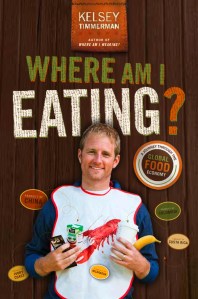
Eating-Cover1In Where Am I Eating?, his follow-up book, Kelsey explores the humble beginnings of his family’s favorite and most common food and drink. His adventure takes him to coffee fields in Columbia, a cocoa plant in Ivory Coast, a banana plantation in Costa Rica, a lobster boat in Nicaragua, and the apple orchards of Michigan (via China).

Both books are completely eye-opening. I definitely had some thoughts, opinions and preconceived notions going into these books. And they changed me. I thought I was doing a pretty good job of researching supply chains (the process by which goods are made), but Kelsey helped me go deeper. Now, I must admit there are some areas where I have more questions than I’d previously had answers. But I believe I have also created some better habits. If these books do one thing, besides make you laugh, they’ll make you think.

I’ll give you two examples:

  1. I was Miss Western Culture holding up my picket sign for “No Child Labor!” before Wearing. But, his book makes you realize that there is so much more to the face, however young, of the issue. It’s a systemic issue, not fixed over night by the banning of goods or mandates set by those on the other side of the world. In cultures where it is normal for kids to work because the adults have already passed their prime, families could starve. Well…that’s not an outcome I want either. There are layers to this issue. I don’t like it, but they’re there. There are so many things that need to happen in those societies before/during/after children are pulled from the work force. Mindsets have to change. Hearts have to change. And people fear change. So, what am I to do? You know, I am still not 100% sure. I know one thing that has to happen is that I have to be informed. So, I learn and I research, and I make the best choices I can with the information I have. And that’s where I’ve landed…for now.
  2. I used to work at an eco-organization, so I thought I had a pretty good handle on food supply. I know what harsh chemicals are used to grow and treat food, and what we label “food” which could more adequately be described as a science experiment. So, I thought I was ahead of the curve on this one. But again, I realized how short-sighted I had been. It made so much sense when reading it. It felt more like a “duh” moment than an “a-ha” moment. And that was because I’d been buying regular produce for thick-skinned items because the chemicals hadn’t reached the food. I’d buy organic for thin-skinned because they were treated with chemicals. Well, despite my efforts and proclamations to be a good global citizen, I’d completely neglected that the people working in the fields with the thick-skinned items (ex: bananas) had been doused in chemicals. I hadn’t given them a whole lot of thought. But I certainly don’t want anyone to be harmed in the process of getting food to my table. I want to know that these items improve their lives, not send them to the hospital or lead them to an early death. So, what do I do now? I buy organic and local as much as I can.


You may be reading this thinking that it’s all well and good for me, but it costs a lot of money to buy organic or a lot of time you don’t have to research clothing. And I get it. I do. I was there once upon a time. But friends, ignorance isn’t bliss. I know the decisions I make when I purchase impact others, and I want those to be good decisions. I do the research and I buy organic because I have personally made it a priority. We all find time, energy, effort and money for the things we decide to make a priority. That’s a fact. Start small.

This is not a guilt trip. It’s just an attempt at a conversation I feel needs to happen. Like I said, these books are funny and honest. Kelsey doesn’t set out to provide you answers and three steps to better buying decisions. He is curious, and he takes you along for the ride. You’ll feel like he’s a friend by the end. I honestly think you’ll want to be a part of the conversation after reading these books. (By the way, Kelsey is very active on social media, so yes, you can actually have a conversation with him. He’s awesome.)

There is good news, however. There are more and more companies who care. I think by making these more informed decisions, we are telling businesses that we want to see more ethical production take place. And I think that’s the best way to move forward.

Besides Kelsey’s books, here are some other resources to get you started:

Free2Work (Website and App: The website has reports on clothing, coffee and electronics)

Purchase With Purpose (Web link: I helped author this one.)

Better World Shopper (Website and App)

Good Guide (Website and App)

If you know of others, please fill me in!


And thank you to Kelsey, for these amazing books. I can’t wait to see what you write next!


(Note: Amazon links are affiliate links.)


Leave a comment

Orange Tour Registration Opens Today!

©2014 The reThink Group, Inc. All rights reserved. www.ThinkOrange.com

©2014 The reThink Group, Inc. All rights reserved. http://www.ThinkOrange.com

Say YES to the Next Generation

Save $40 per person off the regular price for TODAY ONLY! Pay only $49 per person (lunch provided)

OR, register for both the Orange Tour and 2015 Orange Conference at the same time and save! Pay only $259 today only—a combined savings of $149 per person off of the regular rates.


When you “Say YES to the Next Generation,” this year’s theme, it means you say yes to tension, collaboration and debate. There are important questions church leaders wrestle with every week. In fact, many of the questions in ministry are tricky to navigate. This year’s Orange Tour will help attendees discover the best way to answer these questions.

Tour stops for 2014 include Atlanta, Ga., Minneapolis, Minn., Seattle, Wash., Windomar, Calif., Lancaster, Penn., Washington D.C., Detroit, Mich., Indianapolis, Ind., Kansas City, Kan., Charlotte, N.C., Austin, Texas, Dallas, Texas, and Tampa, Fla.

For more information, please visit OrangeTour.org.

If you want some convincing, read Rob Cizek’s article about 7 Things Your Team will get from the Orange Tour at: http://bit.ly/1jKmVLP


Leave a comment

The Orange Conference Live Stream—It’s FREE!

Screen Shot 2013-10-08 at 8.02.48 PM

Over 6,000 of you will be joining us in Atlanta next week! And while we’d love for everyone reading this to be here in person, we realize that’s not always possible. So, we’d like to offer you the next best thing: tune in online! FOR FREE! You’ll be able to see on- and off-stage action, including session streaming, speaker interviews, mayhem and hi-jinx, resource updates and giveaways—and maybe even win a ticket to OC15!

Be sure to RSVP for the Live Stream to receive additional information and special offers. We will not spam you, or sell your info. That’s just rude.

And don’t forget to invite your friends to watch with you!

A full Live Stream schedule will be posted just prior to the conference on this blog.

And if you’re super excited about the Live Stream, but tend to get a little distracted, text “LIVE” to 404-445-2198. We’ll send you text updates about what’s happening, reminders and important info. But we promise not to message you like a sixth grade girl at a One Direction concert.

The Orange Conference, a conference for entire family ministry teams, will be held April 30–May 2, 2014, in Atlanta. Over 5,000 key influencers—senior, next gen, student, children’s and preschool leaders—will gather to experience the power of “Yes,” and learn new insights into influencing the faith and character of the next generation. For more information, please visit www.TheOrangeConference.com.


REPRINTED WITH PERMISSION FROM ORANGE LEADERS.


Leave a comment

Social Ecclesia Conference Highlights

Screen Shot 2014-04-17 at 6.44.24 PMLast month, I attended a nifty new conference called Social Ecclesia with a few of my co-workers. The premise of the event is to help churches with their social media strategy. I think it’s a pretty great idea. These one-day mico-conferences are being held several times per year right now, and are well worth your time and effort if you are a church leader looking to learn more about developing a social approach to sharing the hope of the gospel.

Here are some of the notes I took away from the day.

Justin Wise

  • Authority in the social media age is determined by “who’s around” not “top down”
  • Media is interactive. It’s relational. Engage.
  • Just because people are seeing content doesn’t mean it’s working.
  • A new media culture values customization (iTunes, Netflix, DVR, Twitter, FB, etc.). You can tell when you put content in front of them that they don’t want. They check out.
  • Offline and online is blurred. Teens see social media as a regular part of life.
  • Social media is the new greeter at your church.
  • The FB generation doesn’t want to go to a church that works like a corporation. They want a flexible, interactive community with a cause.

Carrie Kintz at Focus on the Family

  • Van Gogh: I feel there is nothing more artistic that to love someone.
  • People are expressing their brokenness on social media because they don’t feel welcome at the church.
  • “We’re all stories in the end.” – Dr. Who
  • People who volunteer somewhere have happier lives. We are made to serve.
  • To feel loved we must feel known.
  • The church has hope. We need to share it more on social media. (Matt 5:14-16)
  • Don’t let disaster be the first time someone hears from you or your church.
  • Interact with your city’s hashtag.
  • Pray.

Matt McKee

  • Questions change the conversation.
  • How do we leverage social media for the sake of the Gospel?
  • Does the promise meet the practice? If it doesn’t, we fail. This is super important for churches to understand.
  • Online communication should drive offline conversations.
  • Church isn’t limited to an hour each week. Do you have a strategy for both?
  • Ask what problem are you solving?
  • Online presence: 70% interaction 20 content, 10 stats

Tony Morgan

  • Your communication doesn’t matter if you don’t know what a devoted follower looks like and can’t help move them there.
  • People can’t handle too many options. It gets confusing.
  • Increase church activity doesn’t equal spiritual growth.
  • Do your programs reach people outside the church or only satisfy insiders? Ask, “Which ministries is God blessing?”
  • Are your steps clearly communicated?
  • People are attracted to environments where life change is happening.
  • People generally go where they are invited.

Haley Veturis at Saddleback Church

  • Saddleback.com/weaps – their social media plan
  • 3 out of 4 Americans use social media
  • 2/3 of the global population uses social media
  • 13 hour sof video uploaded every minute on YouTube
  • 100K YouTube videos viewed per day
  • 3 million Tweets per day
  • 5 million minutes per day spent on FB
  • Saddleback social media strategy: Connect. Teach. Share.
  • Engage with the people you care about first. Educate community with great content from teachers and speaking pastors. Expose the community to ministry opps.
  • Follow your followers!
  • Go above and beyond when you can. (Disney does this well.)
  • Keep a pulse on the heartbeat of your community.
  • Empower others to be your advocates.
  • 5 Steps in 5 Minutes
  • 1. Identify a social media champion for your church.
  • 2. Check for consistency across channels.
  • 3. Identify your audience on each channel.
  • 4. Follow your followers.
  • 5. Unlink FB/Twitter accounts.

Dave Willis

  • Do people think your phone is your god because you never put it down?
  • Don’t use social media to impress people, use it to impact people.
  • Choose to be an encourager.
  • If you don’t intentionally pull away from social media periodically, then you’re living your life in a digital prison.
  • The impact of your influence will be determined by the effectiveness of your methods and the purity of your motives. Psalm 19:14
  • Criticism is the price of influence. (Luke 6:26, Rom 12:18)
  • Show respect, even to those who don’t deserve it, not as a reflection of their character, but of yours.
  • The best way to build credibility with people is to consistently practice generosity.
  • Always be more interested in gaining followers for Jesus than you are in gaining followers for yourself.

James Andrews

  • The power has shifted from corporations and institutions to individuals and communities.
  • Customer service is the new PR. Effort matters.
  • Social media is the new main street.
  • Create conversations
  • Start with goals before tactics.
  • Be great listeners.
  • PR/Marketing role is to create, monitor, participate and filter
  • Influences and audience aren’t necessarily the same thing.
  • Be you.
  • Remember there are NO rules.
  • Don’t focus on numbers.
  • Convert social connections into real connections.
  • Give something back. Don’t just take.
  • Experiment continuously.
  • Make it easy for people to create data.


3 Comments

The Justice Conference: Highlights

Justice Conference logoTwo weeks ago I headed to LA for The Justice Conference. Any excuse to head to SoCal is a good one, but this event on social justice issues was extra special to me, and at the top of my vacation list this year. So, it made for a great trip!

I posted my Pre-Conference Highlights last week, and now I’ll move on to the main event, held at the beautiful Orpheum Theater. It was a really great day, full of fantastic information, inspiring speakers and like-minded camaraderie.


Ken Wytsma, President of Kilns College and Founder of The Justice Conference

  • When everyone speaks in a prophetic time, we can’t hear the prophetic voice.
  • Remember the poor with deep respect.

1926658_10151924936091540_2004851006_n

Donald Miller, Founder of Storyline Conference, speaker and author

  • It’s hard not to filter your theology through advertising, which says you’re lacking something.
  • Jesus wants us to experience a deep sense of meaning, not necessarily to be comfortable and happy.
  • God is in the business of redeeming hard things.


Nicole Baker Fulgham, founder and President of The Expectations Project

  • Education is a pathway out of poverty.
  • Educated creates engaged citizens.
  • Education gives kids purpose.


Bryan Stevenson, Founder and Director of Equal Justice Initiative

  • 1. We need to commit ourselves to proximity. We must get close to those we want to serve. It will show you things you’ll never otherwise see.
  • 2. Change the narrative. Behind every un-truth, there is a narrative saying it must be this way.
  • 3. Be hopeful to create justice. Sometimes it’s easier to be faithful than hopeful.
  • 4. We have to choose to be uncomfortable.
  • I do what I do because I’m broken too. God is there for the broken. I understand the broken because I am one. God’s grace and mercy fills the broken places.
  • We will not achieve justice with just the thoughts in our minds.


Lynne Hybels, Author of Nice Girls Don’t Change the World

Sami Awad, Executive Director of Holy Land Trust

Marcel Serubungo, Church Mobilization at World Relief Org

  • There is nothing that works in the Congo but the local church.
  • What makes our work different? Jesus.
  • You achieve greater results through love.
  • You can’t give away what you don’t have.
  • Don’t try to do something. Do something.


Justin Dillon, Founder/CEO of Made in a Free World

  • Justice is it’s own art form.
  • Embrace your vulnerability.
  • The world doesn’t need more information, it needs an invitation.
  • Make a world you want to live in.
  • Strive toward the better version of yourself.
  • We’re “shoulding” all over everyone. Stop the should and do.
  • Don’t think problems, think solutions.


Rich Sterns, President of World Vision

Jim Wallis, President and Founder of Sojourners

Noel Castellanos, CEO of CCDA

  • Our faith is connected to the issue of injustice.
  • Immigration reform may be the next Civil Rights movement.


Eugene Cho, Founder of One Day’s Wages, Lead Pastor of Quest Church

  • John 1, Woman at the Well
  • What we do isn’t in isolation. We are representatives of the Kingdom of God.
  • Justice must also do us, not just us doing justice. Otherwise, we just commercialize and commoditize it.
  • People aren’t projects; they are equals.
  • We must learn from those we serve. Place yourself in their narrative to catch a glimpse of who they are.


Stephen Bauman, President and CEO of World Relief

  • Your calling begins with a complaint. There is something you can’t stand for anymore.
  • Our faith will live by justice.
  • We need another reformation. God’s reformation is done through His people.
  • Reformation: a recovery of Truth from the periphery with sacrificial love.
  • What we consider the edges, God considers the center.


Gabriel Salguero, President of the National Latino Evangelical Coalition (and wife)

  • We cannot romanticize the work of justice.
  • 1 Kings 19 (Fire down from heaven)
  • Too many times we think justice work is calling fire down from heaven. But the reality is much more mundane that than. There are small, daily jobs to do.
  • Motivation matters. Check yourself.
  • To stay grounded, stay connected to people.
  • We must fight giants: ego, exhaustion and emotional toxicity.
  • Too often we think justice is talking AT people. Our justice work has become disembodied. It should be incarnational and not third-party.


Bernice King, American Baptist Minister and World-Renowned Speaker, Daughter of Martin Luther King Jr.

  • Conflict is a weapon of growth.
  • True peace is not the absence of tension, but the presence of justice. – MLK
  • Never forget God is on the side of justice. Start there and keep it in sight.
  • God made from one brotherhood all nations.
  • MLK’s strategy of nonviolence will always work because it’s based on Jesus.
  • Courageous people are nonviolent.
  • Nonviolence shouldn’t seek to defeat people, only injustice.


Bethany Hoang, Director of the Institute for Biblical Justice for International Justice Mission

  • Justice begins in the heart of God.
  • We must stop and pray. We are often too busy or in a rush to action to do it, but it will best equip us.


N.T. Wright, Professor at University of St. Andrews, Retired Bishop of Durham, UK, Author

  • Justice is what love looks like.
  • We need discernment because when we think we’ve got justice down, we become arrogant. (Tower of Babel)


Lynne Hybels, Author of Nice Girls Don’t Change the World

  • Ask, “What is mine to do?” and let God help you figure it out. Otherwise you may be overwhelmed by all the causes and issues that need us.
  • God will empower you to do what is yours.
  • God created all the beauty in this world. Fight for it and help it flourish.


That’s all I got! Hope you enjoyed my notes. Fingers crossed that I’ll be able to attend The Justice Conference again next year. It’s a great event, and I recommend going!